Showing posts with label Final Four. Show all posts

Thursday, March 24, 2016

Webster University 2016 Final Four Team

Webster U Chess Final Four 2015

Webster University - SPICE (by USCF rating order) 2016 Final Four Team
Mascot: Gorlok

GM Liem "Man of Steel" Le (Vietnam) - Junior/Finance - 2773
GM Ray "Fearless Attacker" Robson (USA) - Junior/International Studies - 2746
GM Illya "The Brain" Nyzhnyk (Ukraine) - Sophomore/Computer Science - 2720
GM Aleksandr "The Czar" Shimanov (Russia) - Grad Student/MBA - 2708
GM Vasif "Mr. CrossFit" Durarbayli (Azerbaijan) - Senior/Economics - 2686
GM Fidel "Pinar Romancer" Corrales Jimenez (Cuba) - Senior/Computer Science - 2593
Head Coach: GM Susan Polgar
Coach & Team Strategist: FM Paul Truong
Team Assistants: GM Manuel Leon Hoyos, GM Denes Boros, GM Ashwin Jayaram, IM Eric Rosen, IM Irene Sukandar, WGM Katerina Nemcova
The following 4 universities have qualified for the prestigious annual College Chess Final Four Championship:
  • Webster University #1 seed
  • Texas Tech #2 seed
  • University of Texas RGV #3 seed
  • Columbia University #4 seed
Round 1 (10 am – April 2):
Webster vs Columbia / Texas Tech vs UT RGV

Round 2 (5 pm –  April 2):
Webster vs UT RGV / Texas Tech vs Columbia

Round 3 (9 am – April 3):
Webster vs Texas Tech / UT RGV vs Columbia
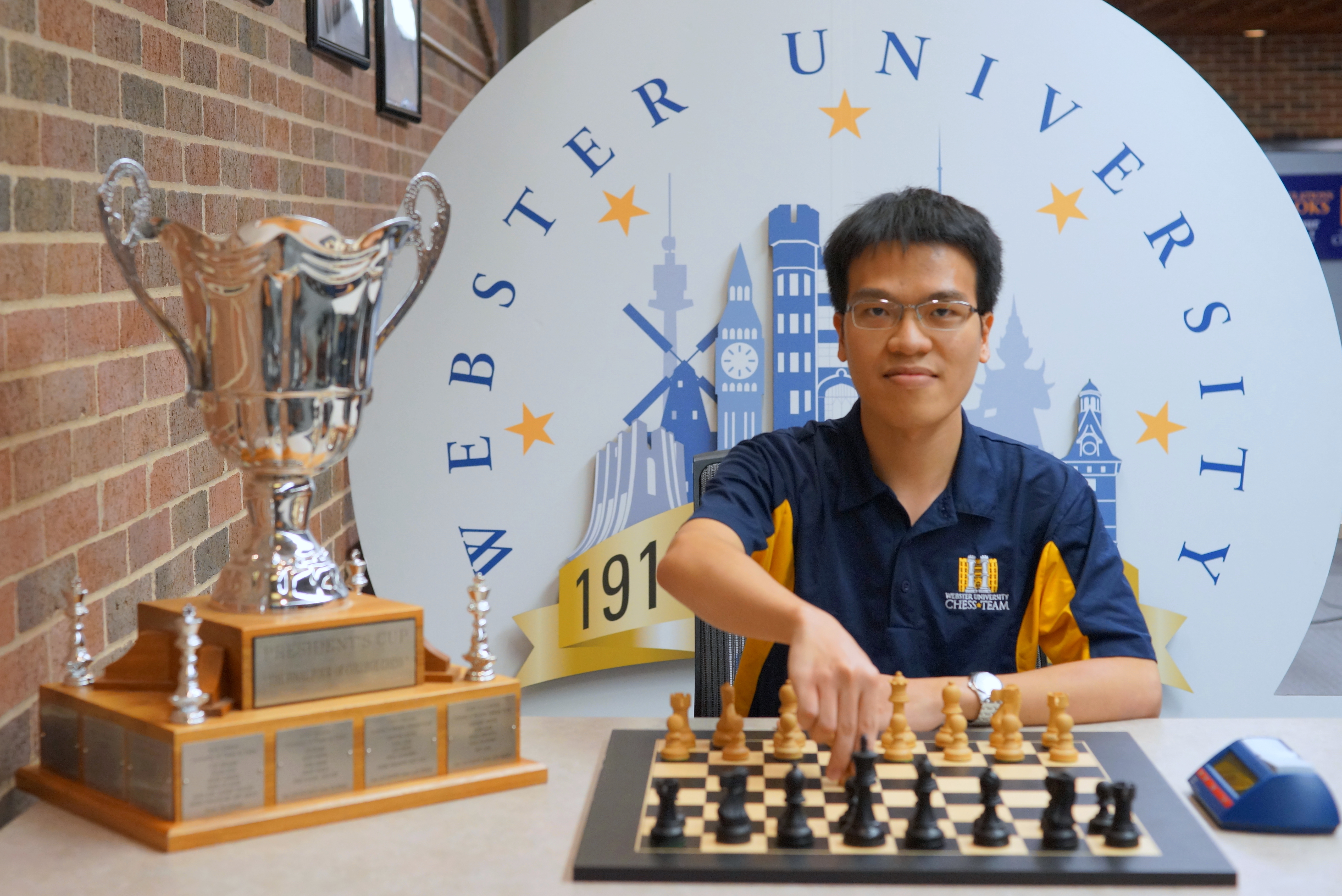
Le Quang Liem-001 (2)
Ray Robson-001 (2)
Illia Nyzhnyk-001 (2)
Aleksandr Shimanov-001 (2)
Vasif Durarbayli-001 (2)
Fidel Corrales-001 (2)

Rules for the 2016 Final 4 of College Chess 

Eligibility:  Each player must satisfy the eligibility requirements established by the USCF College Chess Committee (CCC).  The requirements are the same as those for the Pan-American tournament played Dec 26-29.  If not already provided in advance, each team must furnish the Chief TD with their Eligibility Letter printed on University stationery on Friday evening at the Team Captains’ Meeting. 

Teams:  Each team has four players and up to two alternates.  Board-order based on March ratings (50-point transpositions allowed among USCF ratings) is also determined in the same way as for the Pan-American.

Scoring: The President’s Cup is a Team Round Robin scored by total individual points.  In the event of a tie, the teams are declared Co-champions.  The following tie-breaking systems are for sole possession of the President’s Cup and will be applied in this order:
  1.  Total team match wins.
  2.  Head-to-head outcome.
  3.  Armageddon (5-4 minute “shootout”).  White must win with 5 minutes, and Black must win or draw with 4 minutes.  There is no delay or increment time.  Winner of a coin toss chooses color.  Each team selects one team member to represent them.  This team member can be any Player or Alternate from your Official Team Roster for the tournament, it does not have to be your “Board 1” player.
Team rosters:  Each team’s Official Roster must be presented to the Chief TD no later than Friday at the Team Captains’ Meeting.  Rosters will identify which team member is the Team Captain.  If a Team’s roster is not in Board Order for Round 1, the Team Captain must ensure the Chief TD is aware of your team’s Round 1 lineup.  Round 1 Lineups will be posted by the Chief TD one hour before the start of the round.  After Round 1, Team Lineups for Rounds 2 and 3 must be submitted to the Chief TD at least one hour prior to the beginning of the next round.  Otherwise, if the Chief TD does not receive a Lineup change, he will assume the previous round’s lineup is being used for the next round.  The Chief TD will post the updated Team Lineups on the tournament web site as soon as possible and also will email copies to each team’s point of contact for the tournament.

Team Captains:  There will be a Captains’ Meeting on Friday evening immediately after the Team Dinner concludes.  It usually takes about 30 minutes.  It is at this meeting where we all agree upon rules for certain situations that are not specifically addressed.  At this meeting be prepared to provide the Chief TD with the phone number and email address of your team’s Captain and a backup point of contact.  The Chief TD will use this information to distribute instructions, Lineup Changes, etc. during the tournament.

Communicating with others During Play:  No player whose game is in progress may talk with another person without the Chief TD being present before the communications begin.  This includes players wanting to talk with their Team Captain about whether to accept or decline a draw offer made by the opponent.

Cell Phones, Other Communication Devices and Calculation Devices:  We will discuss this at the Captains’ Meeting on Friday night.  The Chief TD’s initial position is:  No player with a game in progress is allowed to physically possess (e.g. have on their person during the game) or to have access to any communication-capable or calculation-capable device.  If you are playing a game during the Round, don’t bring such devices into the Playing Room.

Sets, Boards and Clocks:  DGT Boards will be provided by the Tournament Organizer for play.  They must be used.  The TD is responsible for the Time Control programmed into the clocks provided by the Organizer, not for incorrect Time Controls set on clocks provided by a team.

Pairings:  The team pairings/seeds are predetermined by the March 2016 US Chess Rating Supplement.  There will be a drawing for Round 1 and Round 3 colors on Board 1 at the Friday evening meeting before the tournament.
  •  Rd 1:  1 vs. 4; 2 vs. 3
  •  Rd 2:  1 vs. 3; 2 vs. 4
  •  Rd 3:  1 vs. 2; 3 vs. 4
Official Time Controls: Game 90 with a 30-second increment each move.
The tournament is FIDE & US Chess rated.

Chief TD:  The Chief TD for this tournament is National Tournament Director and FIDE Arbiter Mike Hoffpauir from Virginia.  Mike has been the Chief TD (and organizer) of several College Final 4 Championships and also has been the Chief of the Pan Ams. 

Saturday, May 31, 2014

2014 Final Four Champions, Back to Back - Webster University!


Round 1

Webster University won 4-0 University of Illinois
TTU won 2.5-1.5 UMBC

Round 2

UMBC lost 1.5-2.5 Webster University
University of Illinois lost 1-3 TTU

Round 3

TTU lost 1-3 Webster University
UMBC won 4-0 University of Illinois

2014 Final standings:

1. Webster University 9.5 points
2. UMBC 7
3. TTU 6.5
3. University of Illinois 1.0


Round 1

Webster University won 4-0 University of Illinois
UTD won 3-1 UMBC

Round 2

UMBC lost 1.5-2.5 Webster University
University of Illinois lost 1-3 UTD

Round 3

UTD lost 1-3 Webster University
UMBC won 2.5-1.5 University of Illinois

2013 Final standings:

1. Webster University 9.5 points
2. UTD 7
3. UMBC 5
4. Illinois 2.5

Saturday, June 15, 2013

About Webster University Chess Team

Webster University Final Four roster:

- Grandmaster Wesley So (board 1 for the Filipino Olympiad team), freshman, who is the No. 1-ranked overall player in the Philippines and No. 2 under 21 player in the world. He also recently reached the "Super" Grandmaster rating, one of only about 50 current players in the entire chess world of more than 700 million players to break that mark.

- Grandmaster Ray Robson (member of the US Olympiad team), freshman, who is the youngest American ever to achieve the Grandmaster title, currently ranked No.6 overall in the U.S. and No. 9 under 21 player in the world.

- Grandmaster Georg Meier (board 2 for the German national team), sophomore, ranked No. 2 overall in Germany. He is a member of the last 2 Final Four Championship teams.

- Grandmaster Fidel Corrales Jimenez (board 3 for Cuban Olympiad team), freshman, the overall No. 3-ranked player in Cuba.

- Grandmaster Manuel Leon Hoyos (board 1 for Mexican Olympiad team), freshman, ranked No. 1 overall in Mexico and reigning U.S. Open Champion. (Alternate)

- Grandmaster Anatoly Bykhovsky, junior, ranked No. 20 overall in Israel. He was a member of the Final Four Championship teams for the past 3 straight years. (Alternate)

Chess Team Accomplishments

The Webster University chess team has been ranked #1 in Division I College Chess since its inception in August 2012. It has never relinquished the top ranking.

National Championships (9)


August 2012

- 2012 U.S. Open Championship: 1st place (GM Manuel Leon Hoyos)
- 2012 U.S. Open Rapid (g/15) Championship: 1st place (GM Andre Diamant and IM Vitaly Neimer)
- 2012 U.S. Open Blitz Championship: 1st place (GM Andre Diamant), 2nd place (GM Anatoly Bykhovsky)

December 2012

- 2012 PanAm Intercollegiate Championship: Both A and B team tied for 1st place
- 2012 PanAm Intercollegiate Championship: Top reserve player (GM Manuel Leon Hoyos)

April 2013

- 2013 College Chess Final Four: 1st place (GMs Georg Meier, Wesley So, Ray Robson, Fidel Corrales Jimenez, Manuel Leon Hoyos, and Anatoly Bykhovsky)

June 2013

- 2013 National Open: 1st place (GMs Wesley So and Manuel Leon Hoyos)
- 2013 National Open Blitz Championship: 1st place (GM Wesley So)

- 2013 National G/10 Championship at National Open: 1st place (GM Wesley So)

State Championships (3)

September 2012

- 2012 Missouri State Championship: 1st place (GM Denes Boros and GM Anatoly Bykhovsky)
- 2012 Missouri State Rapid Championship: 1st place (GM Fidel Corrales Jimenez)
- 2012 Missouri State Blitz Championship: 1st place (GM Fidel Corrales Jimenez)

Major International Events

August 2012

- 2012 World Chess Olympiad (Istanbul, Turkey): Team Silver in Group A (GM Ray Robson - USA)
- 2012 World Chess Olympiad (Istanbul, Turkey): Team Bronze in Group B (GM Wesley So - Philippines)

January 2013

- 2013 World Cup Qualifier: GM Wesley So qualified for the 2013 World Cup which will take place in Tromsø, Norway in August 2013

February 2013

- 2013 Reykjavik Open: Co-champion (GM Wesley So)
- 2013 Grenke Baden Baden Chess Classis: Webster GM Georg Meier drew the reigning World Champion Anand both games in their 2-game encounter

May 2013

- 2013 Calgary International: 1st place (GM Wesley So)

Major U.S. Events (7)

October 2012

- 2012 SPICE Cup Open: 1st place (GM Ray Robson), 2nd place (GM Fidel Corrales Jimenez), 3rd place (IM Vitaly Neimer)

November 2012

- 2012 Thanksgiving Open in St. Louis: 1st place (GMs Georg Meier, Fidel Corrales Jimenez, Denes Boros)
- 2012 SLCC GM Invitational: 1st place (IM Vitaly Neimer)

January 2013

- 2013 Cardinal Open: 1st place (GM Andre Diamant)

March 2013

- 2013 Philadelphia Open: 1st place (GM Fidel Corrales Jimenez)

April 2013

- 2013 St. Louis Open Championship: 1st place (GMs Wesley So, Georg Meier, and Manuel Leon Hoyos)

- 2013 Chicago Open: 1st place (Ray Robson)

Additional collegiate chess records


• 1st team in history (Webster University) to be ranked #1 in the nation in the first year of forming a team (August 2012 - now)
• 1st team in history (Webster University) to qualify for the Final Four in the first year of forming a team (December 2012)
• 1st team in history (Webster University) to be seeded #1 in the Final Four in the first year of forming a team (April 2013)
• 1st female (Susan Polgar) to coach a men's team to the National Championship (2011)
• 1st female (Susan Polgar) to coach a men’s team to back to back National Championships (2011-2012)
• 1st female (Susan Polgar) to coach a men’s team to 3 straight National Championships (2011-2013)
• 1st coach, male or female, to win National Championships with 2 different schools (TTU 2011-2012, and Webster U 2013)
• 1st college team with 4 GMs (Fall 2011)
• 1st college team with 5 GMs (Spring 2012)
• 1st college team with 8 GMs (Fall 2012)
• Most points scored in the Final Four (April 2013 - Webster University finished with 9.5 points)
• Largest margin of victory in the Final Four (April 2013 - Webster University finished 2.5 points ahead of 2nd place UTD)
• 1st person (Susan Polgar) to be named College Chess Coach of the Year (April 2013)

Monday, April 29, 2013

Finally hoisting the Final Four Championship Cup!


The Webster University Final Four Championship team finally has a chance to hoist the President's Cup today, April 29, instead of April 7 at the Closing Ceremony.

Monday, April 15, 2013

Another College Chess Record

After this past weekend at the St. Louis Open, 3 members of the Webster University Final Four Championship team are now above 2700 (USCF) at the same time. This is the first for any American collegiate chess team.

GM Wesley So is now at 2728 USCF. His LIVE FIDE rating is 2705, which makes him the 41st ranked player in the world. He is also the #2 junior in the world, and #1 in the Philippines.


GM Georg Meier is now at 2702 USCF and ranked among the top 100 in the world. He is the top German born player and a key member of the German European Championship team last year.


GM Ray Robson's latest rating is 2700 after the Final Four. He is currently the #1 American born (representing the US) player on both the USCF and FIDE list. He is also the #9 junior in the world.


All three are members of their national team at the Olympiad.


Incoming Webster U freshman GM Le Quang Liem of Vietnam is rated 2802 USCF and 2717 FIDE. He will be the first American collegiate player to be above 2800 in USCF rating. Liem is also the former #1 junior in the world and the #1 rated player from Vietnam.


There are 3 requirements for any SPICE members:

1. They must focus in their school work to maintain good grades. My standard is much higher than the standard required by the College Chess Committee. The grade point average of the team is around 3.6 / 4.0 and all students are taking full loads.


2. They must be willing to work hard on their chess to improve. So far, players from SPICE have all reached their peak ratings during their tenure with the program.


3. They must conduct themselves in a professional manner to represent themselves, Webster University, SPICE, their families, and their countries well. 

Wednesday, April 10, 2013

All The Right Moves

 
All The Right Moves 
Area boasts a pair of national chess team champions: Vianney High & Webster University 
by Jaime Mowers 
April 12, 2013
A pair of local chess teams are basking in the glow of recent national championship wins.

Webster University's Gorlocks and St. John Vianney High School's Golden Griffins are celebrating their national titles. Webster University won the Final Four of college chess in Rockville, Md., last weekend, while Vianney garnered top honors in its division in the U.S. Chess Federation's SuperNationals V K-12 tournament in Nashville.

Webster University's collegiate chess team is tops in the nation, having won the competition. Also known as The President's Cup, Webster entered the Final Four tournament as the top seed. The team has four starters and two alternates, all of whom are ranked as chess grandmasters by the World Chess Federation. In fact, the entire Webster chess team includes eight grandmasters -- unheard of in the world of collegiate chess.

The tournament ended just past noon on Sunday, April 7, with Webster University victorious in its match against the University of Texas-Dallas. A celebration welcoming the national champions back from the competition was held on Monday, April 8, in Marletto's Cafeteria on Webster University's main campus.


Webster's six Final Four team members include grandmasters Wesley So, Ray Robson, Georg Meier, Fidel Corrales, Manuel Leon Hoyos and Anatoly Bykhovsky.

Webster has been ranked number one in the nation since August 2012, when the team was officially formed. Susan Polgar, Webster's chess head coach, said this is the first time in history that a first-year collegiate chess team has gone to the Final Four, much less claim a national title.


Polgar said she hopes the team will have many more national championship titles in its future.

"It's a great honor and I'm very proud of bringing the first collegiate chess title to Webster University and St. Louis - I hope it's the first of many more," she said. "I'm very proud of the team. They've worked extremely hard over the past several months not only on their chess movements, but on their physical fitness to be ready for the competition."

Polgar said many people don't realize how demanding chess can be. The team played for 10 hours during the first day of competition and four hours on the second day.

"It's actually very grueling because of the length of the competitions," she said. "Even sitting and focusing your fullest attention for four or five hours at a time can be difficult."

Polgar would like to thank everyone who has supported the chess team including the Webster University administration, St. Louis and many community members.

The Final Four is the most prestigious team tournament in collegiate chess; the winner is known as the national champion of college chess. In addition to Webster University, the other three teems in the final four were the University of Maryland-Baltimore County, University of Texas-Dallas and University of Illinois.


More here.

Monday, April 08, 2013

Webster Celebrates College Chess Title


Webster Celebrates College Chess Title, As New Hire Pays Off 
by Alan Greenblatt 
April 08, 2013 3:39 PM 
NPR

If there's no such thing as bad publicity, how much is good publicity worth? Webster University wants to find out.

Last year, the university didn't have a chess team. On Sunday, its team took home the national college championship, the President's Cup, after winning what is often called the "Final Four" of chess.

Webster, which is located just outside of St. Louis, picked up its team nearly intact last year from Texas Tech. The university hired coach Susan Polgar, who had won two straight championships in Texas, and the whole team came along with her.

Webster's chess team includes eight grandmasters. It's become instantly so dominant that two of its squads qualified for the chess Final Four, although only one was allowed to play.

When it comes to winning championships, Polgar and her players "have been there, individually and collectively," Webster provost Julian Schuster said Monday at a campus rally celebrating the team's victory.

"Let us thank them for what they've done for us," Schuster said. "For the first time in the almost 100-year history of our university, we are the national champion."

Webster, which is now private and non-denominational, was founded as a Catholic women's college and has become known over the years for its performing arts programs and its business school. Its main campus is in the St. Louis suburb of Webster Groves, but Webster boasts almost 100 satellite campuses around the world.

Schuster said in an interview that chess was part of his upbringing in Yugoslavia and that his primary goal in bringing Polgar to Webster was incorporating the game into the intellectual life of the university.

Still, he added, "there's no doubt" that their victory is good news for the university.

At the celebration, members of Webster's media relations team counted reporters in attendance, noting that the weekend tournament had garnered the university national attention (including from NPR).

"The Washington Post was the big one," said Patrick Giblin, Webster's director of public relations, referring to a front-page story that ran Saturday.

Chess has become big business in the St. Louis area. The World Chess Hall of Fame moved to the city two years ago, while St. John Vianney High School in nearby Kirkwood won its second national championship this weekend.

Webster's own champions looked a little shy and sheepish as they entered the campus lounge with their big trophy in tow, joining school administrators and someone wearing the costume of the campus mascot, the cheetah-buffalo-St. Bernard blend Gorlok.

There were no pom-pom girls, tipped cars or burning mattresses, but there were cookies in the shapes of chess pieces.

"I wasn't even aware there was a team," said Brieanna Lee, a psychology major sitting in the lounge, eating french fries and ranch dressing.

But Lee admitted their victory in the chess Final Four was "an accomplishment." Other students who happened to be in the lounge said they "lived in the music basement" or were otherwise "too busy" to follow the chess team, but generally agreed its triumph would help their school nonetheless.

Success builds upon success. Most of Webster's grandmasters hail from other countries, but one of the players from Vianney's winning chess team has expressed an interest in joining them from neighboring Kirkwood.

"What we hope is that the success of our chess team will be perceived as the success of the university in general," Schuster says. "It will permeate through everything we do and will speak to how we do things in the future."

Source: http://www.npr.org

Bringing National Championships to St. Louis

St. Louis quietly celebrates two national chess titles
April 09, 2013 12:05 am • By Jesse Bogan 
St. Louis Post Dispatch

WEBSTER GROVES • As thousands gathered Monday for the Cardinals home opener, two other local teams -- the Gorloks and Golden Griffins -- were already celebrating national championships, but in a much lesser followed event: chess.

Webster University won the Final Four of college chess in Rockville, Md., over the weekend, while St. John Vianney High School took top honors in its division in the U.S. Chess Federation's Supernationals V K-12 tournament in Nashville.

The wins are the latest nod to St. Louis, home of the World Chess Hall of Fame, as it tries to establish itself as the chess mecca. 

As quietly as the game is played, so are its championship celebrations quiet compared with mainstream collegiate football and basketball competitions. About 100 people gathered Monday in a Webster University cafeteria to welcome their winning team home.

Some hooted and hollered. Other students watched curiously from a distance as they ate lunch in silence.

Julian Schuster, provost at Webster and chess enthusiast, told the crowd that the win came from "hard work" and "vision."

"This a great day for all of us," he said.

Not only is it the school's first national chess championship, it's the first year it fielded a team, school officials said. 

Webster's bid to become a chess powerhouse happened just nine months after luring grandmaster and coach Susan Polgar away from Texas Tech University in Lubbock.

Traditionally thought of as a man's game, Polgar has not only broken the mold, but dominated. Originally from Hungary, this is her third national collegiate chess championship in a row as head coach.

Two of the six players on Webster's winning team followed her from Lubbock. The four others recently came to Webster to play chess for Polgar and the Gorloks, named for the private school's mascot.

All six of the championship players -- including two alternates -- are grandmasters, or top players in chess.

"We hope its the first of many national titles," said Polgar, 44, who wore blue high heels, black slacks and coat with a white T-shirt -- "2013 National Champions."

The players come from all over the world. They are Georg "German Precision" Meier, Wesley "Asian Tiger" So, of the Philippines, Ray "Fearless Attacker" Robson, of Florida, Fidel "Casanova" Corrales Jimenez, of Cuba, Anatoly "Speedy Rocket" Bykhovsky, of Israel, and Manuel "Yucatan Conquistador" Leon Hoyos, of Mexico.

Bykhovsky, who followed Polgar from Texas Tech, won the last match of the tournament. The game lasted four hours. The junior is studying finance. He said he started playing chess young and became a grandmaster by 21.

"I am going to eat with my girlfriend, it's a nice day," he said of how he was going to celebrate.

Leon, 24, a freshman studying economics, won the U.S. Open and is a 4-time Mexican Open champion. He said that many things set his coach apart.

"I feel like I learn just speaking, knowing what her opinion is about many things," he said. 
But Leon couldn't visit long. He had an Italian exam to run to after the celebration in the cafeteria.


Meanwhile, Webster University won its tournament with 9.5 points, beating University of Texas-Dallas, which had 7 points, University of Maryland Baltimore County, 5, and the University of Illinois, 2.5.

Webster dethroned UMBC, the former powerhouse in Maryland. What's more, Alan Sherman, UMBC’s chess director, had predicted Webster would win.

“I think Webster just decided they wanted to win and if they invested more money, they could just outdo the others,” Sherman recently told the Washington Post. “They have the strongest team in the history of college chess. Unlike the UMBC model, where we ramped up over a period of five years, they bought their team in a year.”

Polgar left Texas Tech less than a year ago. Schuster, the Webster University provost, helped lure her here. Both he and school president Beth Stroble traveled to Maryland over the weekend to root for their team.

"Our goal is for these young people to be ambassadors of the university, which they are, and to graduate and go on to great lives," Stroble said in an interview.

A few minutes later, she told the celebratory crowd: "I am proud of an accomplishment that is as strategic and intellectual and academic as it is competitive in any other way."

As a player, Polgar said, she was the first woman to win the grandmaster title and the first woman to qualify for the men's world championship. Now, she said, she mainly just plays chess by computer.

As a coach, she said, she sets herself apart by training players not to attack early, but also by focusing on life away from the chess board. She said the team celebrates birthdays, plays soccer to try to have fun and be in a supportive environment.

"It's a combination of things," she said of her success in coaching. "High expectations. Working hard for it and focusing on team chemistry."

Physical fitness is part of it, too. It's not uncommon for a day's competition to last 10 hours.
"People usually don't realize how important endurance is in a chess competition," she said. "It's very grueling."

She said she left Texas Tech because of a lack of a budget that was promised. She said there was also a lack of understanding and respect for chess there. 

"You know how Texas is everything is about football, football, football, and then maybe some basketball and baseball, chess certainly is not on the list."

She said she liked the chess culture in St. Louis, which hosts the U.S. championship and other competitions.

"We are very comfortable with how chess is being respected as an activity, practically like football would be respected at Texas Tech," she said.

Regarding the small turnout compared with the Cardinals home opener, she said: "I understand it's not like baseball yet, but we are working on you guys."

Full article here: http://www.stltoday.com

Webster wins Final Four


Webster wins Final Four of chess, with UMBC finishing third 
By Michael S. Rosenwald,
April 07, 2013
Washington Post

Webster University won the Final Four of college chess in Rockville on Sunday, dominating the University of Texas-Dallas and the University of Maryland Baltimore County, the hometown favorite and former powerhouse.

UMBC finished third, behind UT-Dallas.

The victory was Webster’s first Final Four championship, but not the first title for its coach, Susan Polgar, who left her job directing the Texas Tech program last year after two consecutive Final Four victories.

Polgar’s team of grandmasters followed her to St. Louis — an unprecedented event in collegiate chess that made national headlines.

“I think Webster is now clearly the dominant force in chess,” said longtime UMBC chess director Alan Sherman. “There’s no doubt about that.”

UMBC perfected the modern collegiate chess model, offering scholarships to grandmasters from around the world, racking up championships and generating positive PR. But UMBC is increasingly the underdog now. The school has won just two Final Four titles since 2007 after winning four straight in the mid-2000s. Sherman predicted Webster’s win last week.

Webster finished with 9.5 points in the round robin tournament with four players competing for each team. UT-Dallas had 7 points, while UMBC had 5 and the University of Illinois scored just 2.5.

UMBC was out of the running for the title after the first two rounds on Saturday, when it scored just 2.5 points. The school lost its head-to-head match against Webster, 2.5-1.5, and fell to UT-Dallas, 3-1.

Webster and UT-Dallas squared off Sunday morning for the title, with each school playing four grandmasters. (UMBC came into the tournament with two grandmasters.) Webster won the round, 3-1.

“I’m very happy for the team and proud of the way we prepared,” said Polgar, whose bosses, the president and provost of Webster, traveled to Rockville for the tournament.

Polgar will not, however, bring home the tournament’s coveted President’s Cup trophy.

Before the tournament started, Polgar tweeted that her former employer, Texas Tech, “forgot to send back the President’s Cup. Now the winning team will not have the cup to bring back. 1st time cup was not returned.”

Source: http://articles.washingtonpost.com

History making feat

Webster University made history when it became the first St. Louis team ever to win a Final Four collegiate chess championship. Webster’s top-ranked chess team emerged victorious in the President’s Cup – also known as the Final Four of Collegiate Chess – a two-day throw-down that determines the national champion of college chess teams. The tournament was held Saturday and today in Rockville, Md.

This is the first time in history a team made it to the Final Four of Collegiate Chess in its first year at a school and also the first time that a first-year team has been ranked as the No. 1 seed in the Final Four. Webster’s chess team has ranked No. 1 since August 2012, when the team was officially formed.

Webster will welcome the national champions back to campus during a lunch-time ceremony on its Webster Groves campus Monday.

“Congratulations to all the members of our team and all who support them, as I know that they have worked hard to prepare for this moment,” said President Beth Stroble, who was in the Washington, D.C. area this weekend to watch the Final Four. “Their competitors were smart, tough, and skilled and there were many tense moments this weekend, which makes this championship particularly significant for Webster University. I couldn’t be prouder.”

“Today was a great day for chess, for Webster and for Webster’s chess team, and for all of our students who worked hard to win this tournament,” said Provost Julian Schuster, who also accompanied the team to the Final Four competition. “We are all winners because this accomplishment came about through the hard work and dedication from the people who love chess, who love Webster, and from all our supporters in the community. We are proud of all of our students and are proud of the chess program, and we look forward to many more years of championships.”


The Final Four is the most prestigious team tournament in collegiate chess; the winner is known as the national champion of college chess. To get to the Final Four, teams must first compete in the Pan American Intercollegiate Team Chess Championship, held each year during the last week of December. Only the top four teams in this event qualify for the Final Four. This year, in addition to Webster, other schools competing in the Final Four were the University of Maryland-Baltimore County, University of Texas-Dallas and University of Illinois.

In the round robin-format Final Four, each of the four school teams played in three rounds of competition, playing one full match against each of the other schools. Each game won was one point to the school, and each draw was one-half point. Game points determine the overall winner.

While Webster entered the competition in the top spot, the win was not easy. Webster swept Illinois in the first round, earning four points, and in the second round against Maryland the team drew three games and won the fourth. By the end of the day, Webster only led University of Texas by one-half point at 6.5 to 6.

In the final round on Sunday, Webster faced the Texas team. Two of the games were a draw, and Webster won the final two matches, earning 9.5 points to Texas’ 7.

“It was a nail-biter down to the final moments,” said Susan Polgar, the chess team coach. “We had a win and draw when the first two games ended in the third round, but with two more games going, there was still a chance that Texas could still defeat us. When we clinched the championship with a draw and a win on the last two boards, everyone in the room jumped to their feet in excitement.

“We are very appreciative of all the people at Webster who cheered us on, especially all the Webster alumni and employees in the D.C. area who were able to come to the championship to show us support,” she added.

During Sunday’s awards ceremony at the competition, Polgar was named the “College Chess coach of the year.” This is the third team in a row that Polgar has coached to a President’s Cup victory. Before joining Webster, Polgar was the coach for Texas Tech’s chess team, which won in 2011 and 2012.

With eight grand masters on its team, Webster sent six of them to the Final Four, including four freshmen who had never previously competed in the Final Four: Georg Meier, an international business major and a sophomore, Wesley So, a freshman finance major, Ray Robson, a freshman who is still exploring majors, Fidel Corrales Jimenez, a freshman computer science major, Anatoly Bykhovsky, a finance major and junior, and Manuel Leon Hoyos, an economics major and freshman.

Webster will host a ceremony for the winning team at 11:30 a.m. Monday, April 8 in Marletto’s, the student cafeteria located on the ground floor of Loretto Hall on the Webster Grove campus. The event is open to the campus community.

With its home campus in St. Louis, Webster University (www.webster.edu) is the only Tier 1, private, non-profit U.S.-based university providing a network of international residential campuses. Founded in 1915, Webster University’s campus network today includes metropolitan, military and corporate locations around the world, as well as traditional residential campuses in Asia, Europe and North America. The university is committed to delivering high-quality learning experiences that transform students for global citizenship and individual excellence.

For more information on Webster’s chess team, visit http://webster.edu/spice/.

Thursday, April 04, 2013

You Should Have Had Webster in Your (Chess) Bracket


You Should Have Had Webster in Your (Chess) Bracket 

Webster University Chess Team Enters Tournament as No. 1 Seed Webster University is heading to the "Final Four of Collegiate Chess" (also known as the President’s Cup) April 6-7 in suburban Washington D.C. 

The tournament is the final throw-down in determining the U.S. collegiate team chess champion. 

ST. LOUIS, April 4, 2013 – The NCAA “Final Four” will be under way at the Georgia Dome this weekend, but there will be another Final Four tournament taking place at the same time: the "Final Four of Collegiate Chess" (also known as the President’s Cup), to be played among the nation’s top four college teams, April 6-7 in suburban Washington D.C. The tournament is the final throw-down in determining the U.S. collegiate team chess champion.

Webster will enter the tournament as the top seed, because of the players’ high international and national chess ratings and rankings. Webster’s team has four starters and two alternates, all of whom are ranked as chess grandmasters by the World Chess Federation. In fact, the entire Webster chess team includes eight grandmasters -- unheard of in the world of collegiate chess. The entire country of Canada only has nine grandmasters.

Susan Polgar, Webster’s chess head coach, said this is the first time in history that not only has a collegiate chess team made it to the Final Four in its first year at a school, but the first time that a first-year collegiate chess team has been ranked No. 1 in the Final Four. In fact, Webster has been ranked No. 1 since August 2012, when the team was officially formed. 


Webster’s six Final Four team members include:

*       Grandmaster Wesley So, freshman, who is the No. 1-ranked overall player in the Philippines and No. 2 under 21 player in the world. He also recently reached the "Super" Grandmaster rating, one of only about 50current players in the entire chess world of more than 700 million players to break that mark. 
*       Grandmaster Ray Robson, freshman, who is the youngest American ever to achieve the Grandmaster title, currently ranked No.6 overall in the U.S. and No. 9 under 21 player in the world.
*       Grandmaster Georg Meier, sophomore, ranked No. 2 overall in Germany. He is a member of the reigning Final Four Championship team.
*       Grandmaster Fidel Corrales Jimenez, freshman, the overall No. 3-ranked player in Cuba.
*       Grandmaster Manuel Leon Hoyos, freshman, ranked No. 1 overall in Mexico and reigning U.S. Open Champion. (alternate)
*       Grandmaster Anatoly Byhkovsky, junior, ranked No. 20 overall in Israel. (alternate) He was a member of the Final Four Championship team the past two years. 

The Final Four is the most prestigious team tournament in collegiate chess; the winner is known as the national champion of college chess. To get to the Final Four, teams must first compete in the Pan American Intercollegiate Team Chess Championship, held each year during the last week of December. Only the top four teams in this event qualify for the Final Four. This year, in addition to Webster, other schools competing in the Final Four include the University of Maryland-Baltimore County, University of Texas-Dallas and University of Illinois. 

In the round robin-format Final Four, each of the four school teams plays in three rounds of competition, playing one full match against each of the other schools. Each team fields a squad of four players, meaning that each team will play a total of 12 games. Game points determine the overall winner. 

Updates from the Final Four will be posted on Webster’s Twitter account at @WebsterU this weekend. A celebration welcoming the team back from the competition will be held at 11:30 a.m. on Monday, April 8 in Marletto’s. It is open to the campus community and will include a special treat from President Stroble. 

Source: http://www.webster.edu

Tuesday, November 20, 2012

Official College Chess Rules


Intercollegiate Eligibility Requirements:

Rule 1

For college and university teams, titled players (International Masters, International Grandmasters, International Woman Masters and International Woman Grandmasters) are eligible to participate if they satisfy at least one of the following stipulations: #1 or all three conditions listed in #2.

1. Are less than 26 years old as undergraduate students, or under 30 years old as graduate students, as of September 1 of the academic year in which the tournament takes place.

2. Satisfy all of the following three conditions:

a) Are full-time, degree-seeking students (e.g., at least 12 semester credit hours for undergraduate students and 9 semester credit hours for graduate students)

b) Have a grade-point average of at least B (e.g., at least 3.0 on a 4-point scale)

c) Have satisfied conditions 1 and 2 for at least one full semester at their team’s college or university prior to the event.

Rule 1 applies to all college events — individual or team. There are no age restrictions on players not having the four above-mentioned international titles.

Rule 2
College and University players shall be enrolled at least half-time (e.g. 6 semester credit hours) during the semester of eligibility. For the Pan American Intercollegiate Team Championship, traditionally held between Christmas and New Year’s each year, players must be enrolled in the fall semester preceding the event.

Rule 3
College and university players shall be eligible to play for a total of six years, where a year is defined as being either a traditional academic year of a fall and spring term or a fall term or a spring term, e.g., a player enrolled in spring of 1998, spring of 1999 and fall of 1999 is considered enrolled for three years under this rule.

Rule 4
College and university players shall be enrolled in a degree-seeking program with a cumulative grade point average of at least a C.

Rule 5
College and university players shall be resident at their campuses either in on-campus housing or in housing within reasonable commuting distance from campus, e.g., a player taking distance learning courses from another country shall not be eligible to play.

Rule 6
Colleges and universities offering chess-related scholarships shall maintain records about the individuals awarded such scholarships, their time of attendance, the degrees received if any, and the grade point average attained.

Rule 7
Faculty, staff and alumni are not eligible to compete in the National Collegiate Chess League Team Championship conducted over the internet each spring.

The following are suggestions offered for guidance:

Faculty conflicts. A faculty member serving as a consultant or director to a university or college chess program should adhere to the following guidelines:

  • To admit no player to their program who does not, in their judgment, demonstrate a serious likelihood of achieving a degree.
  • To not offer independent study courses to members of the chess team.
  • To not recruit players from other chess programs.
  • To scrutinize carefully undergraduate students applying for a second baccalaureate.

Non-compliance:

1. Winning teams should file a report to document compliance with these regulations with the USCF.

2. Any team’s standing may be challenged for non-compliance by a competing team through a written complaint sent within 30 days to the Executive Director or the Scholastic Director of the U.S. Chess Federation. That official shall gather the relevant documentation of the complaint, make a recommendation as to disposition, and send it to the USCF Executive Board for resolution.

2d. Team Requirement:
  1. The Pan-Am Intercollegiate Team event is a strict team-on-team competition. Pairings are done by considering each team an individual entity.
  2. A team is made up of four players plus up to two optional alternates.
  3. When alternates play, they must do so starting on the lowest boards. Any regular team member may sit out when an alternate plays; other team members move up accordingly.
  4. Teammates must play in descending rating order, except that 50-point transpositions are allowed. Board order must remain the same throughout the event. Each team must submit a roster before the close of registration indicating the fixed lineup.
  5. Teams are ranked in order of the average of four highest individual ratings – this includes the alternates. The team average rating is used for wall chart ranking and class-prize eligibility.
  6. Unrated players must be placed below rated players.
  7. A team must have a minimum of three players to compete for prizes. In the event that only two players arrive from a school before round 1, they will be allowed to compete provided their teammates are expected to arrive. If these teammates do not arrive, then the two who did arrive are ineligible for all prizes.
  8. There may be no mixed teams. For example, if two schools arrive with only two players, the four may not form a team, even if they volunteer to forego prize eligibility.
  9. A school may send an unlimited number of teams. There is no rule regarding the composition of multiple teams (e.g. they may be balanced or in order from highest to lowest rated), only that individual members of each team must be in strict descending rating order. Multiple teams will be designated as “A,” “B,” “C,” etc., with “A” designating the team with the highest average rating. 
  10. All teams must designate a coach or captain (he/she need not be a competitor, just affiliated with the team’s school). The role of the coach/captain is: 
  11. To turn in his team line-up to the TD at least one hour before the round begins.
  • To see that his/her team arrives on time for each match.
  • To see that his/her team plays in correct board order.
  • To advise his/her players whether or not to accept or offer a draw.
  • To report the result of the match to the TD.
  • To check the wall charts for accuracy.

Note: “Package deals,” such as offering draws on boards 1 and 4 to the opposing team captain, are not permitted.

2e. Ratings of Players:
  1. American players use their USCF ratings reflected in the December Rating Supplement, which is made available before the Pan-Am. TDs should have access to the online USCF rating supplements.
  2. Unrated players do not affect the team average.
  3. Foreign players who have national or FIDE ratings must present evidence of this rating, and then the rating will be converted. The conversion table is as follows:
  • Canada (CFC): Add 50
  • Quebec (FQE): Add 100
  • Most other nations: Add 200
  • New USCF/FIDE conversion formulas:
  • FIDE Under 2000, USCF = FIDE rating x 5/8 + 720
  • FIDE 2000 and above = FIDE rating x 1.16 – 350
If a foreign player has two or more ratings (USCF, FIDE, national, etc.), the highest rating after conversion will be chosen. There is no rule that states a team must use the same rating system on each board (e.g. all FIDE or all national).

2f. Conduct of the Tournament:
A team may not deviate from its given roster after sign-up. If it is found that players were placed out of order, and the error was the TD’s, the proper order will be established in the next round. In this case, previous results will count, both for the team and for individuals. If players were placed, or played out of order, and the error was the team’s, then the team may face forfeiture.

To the extent possible, the top boards should be roped off to highlight the top contestants and also to prevent congestion. Some events have highlighted these boards by isolating them in a central area.

Organizational announcements should be made just prior to the beginning of each round.

2k Tie-breaks:
Tie-breaks are used to award places and trophies only. Cash prizes are divided equally in any tie.

If two teams are tied for first, they are considered co- champions. Tie-breaks are used to determine which team name “goes first” in articles, and which team gets the larger trophy. The recipient of the second place trophy can have it send it for a new engraving declaring that team “co- champion.” If three or more teams tie, tie-breaks are used to determine first, second, third, etc. places. If two teams or individuals tie for a prize other than first place team, tie-breaks are used for place plus trophy allocation (no new engraving need be sent).

When team match points are equal, the following order of tie-break systems will be used: U.S. Amateur Team East (USATE). In the USATE system, you multiple your wins against each individual opponent’s final score. Thus, if you defeated a 1st round opponent by a 3-1 score and they ultimately scored 2-4 in the Pan-Am, your team would then get 6 tie-break points (3×2). If you drew 2-2 in round two against a team that would ultimately score 5.5-.5, then you get 11 tie-break points (2×5.5).

For individual board prize determinations, the tie-break procedure is total points scored, then
  • Winning percentage
  • Median
  • Solkoff
  • Sonnenborn-Berger
  • Cumulative
  • Kashdan
  • Result between tied players
  • Most Blacks
  • Result between teams of tied players
  • Coin flip

3. Ceremonies:

3a. Opening Ceremony:
The organizer is encouraged to arrange a brief opening ceremony an hour prior to the start of the first round. A reception should be prior to the opening ceremony. A minimum of $1000 is required to fund this function.

Local dignitaries, deans or faculty from the host school, and the press should be invited. Past experience has shown that local officials have great interest in participating in such ceremonies. Proclamations from a host college, mayor, county executive, and governor might be available upon request from their respective offices.

3b. Awards Ceremony & Prizes:

The organizer is responsible for an awards ceremony in keeping with the stature of a national championship.

The list of prize winners must be posted as soon as possible. The awards presentation order should be announced at the start of the ceremony.

Money prizes shall be given out in the form of checks by the organizer to the proper team recipient (or affiliate) at the awards ceremony if the winner is present. Prizes may be awarded early if the winner has to leave before the awards ceremony. In the event that prize winners have to leave and games are still in progress affecting the prize, the organizer may choose to send all or part of the prize by mail.

The recommended minimum prize fund in the intercollegiate section is $4,000. Division prizes are based on average team rating. Guaranteed prizes are preferred, though based-on prizes are acceptable. Division ratings are as follows:

Division I 2200 and above Division III 1800-1999
Division II 2000-2199 Division IV Under 1800

Trophies, plaques, or clocks should be given out in addition to all cash prizes for top board scores and top foreign teams (non-USA).

An additional prize for each of boards 1-4, called “class board prizes,” should be awarded. Prizes are determined by the highest number of points scored.

4. Miscellaneous:

4a. Chess Notation:
Chess notation (or use of a Mon Roi unit) must be kept consistently and legible by all players.

The organizer should provide carbon scoresheets for all games. These are the property of the organizer, and clean copies must be turned in.

Organized side events add to the attractiveness of the Pan-Am. Such activities traditionally include the Pan-Am Speed, Chess Championship. A Pan-Am Open (a regular, open event), and simuls or lectures by famous players are highly recommended.

4b. Posting of rules:
A copy of the Pan-Am Rules should be posted on the College Chess Website.